
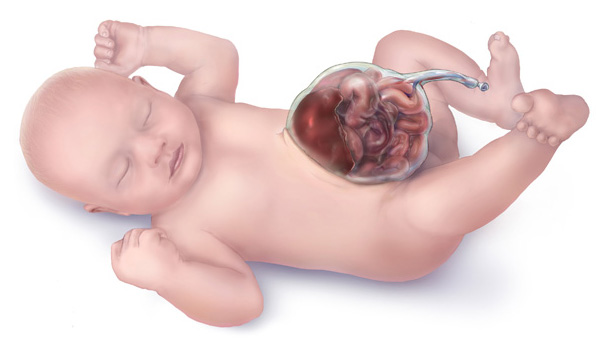
🤰 Omphalocele: Causes, Risk Factors, & Treatment
An omphalocele is a congenital abdominal wall defect in which the baby’s intestines, liver, and sometimes other organs remain outside the abdomen, enclosed within a translucent, protective sac.
🔍 Differences Between Omphalocele & Gastroschisis
While both are congenital abdominal wall defects, they have distinct structural differences that change how they are managed:
| Feature | Omphalocele 🛡️ | Gastroschisis ⚠️ |
| Protective Sac | Present. Organs are safely enclosed in a membrane. | None. Intestines are entirely exposed to amniotic fluid. |
| Location | Directly through the center of the abdomen (the umbilical ring). | Usually to the right of the belly button. |
| Organs Involved | Frequently includes the intestines, liver, and stomach. | Primarily the intestines; rarely the liver. |
| Development | Results from a failure of the abdominal muscles to close fully around the base of the umbilical cord. | Results from a physical breach or failure in the anterior body wall structure. |
📋 Risks, Diagnosis, & Postnatal Complications
An omphalocele occurs in approximately 1 in 10,000 live births.
Prenatal Diagnosis
-
Screening: Typically flagged in the second trimester via an elevated maternal serum alpha-fetoprotein (MSAFP) test.
-
Confirmation: Confirmed via a routine prenatal ultrasound, which can clearly identify the sac and the organs inside it.
Major Complications
When a large portion of the fetal liver protrudes into the umbilical cord, it fundamentally alters the baby’s structural development:
-
Underdeveloped Abdomen: The internal abdominal cavity remains abnormally small because the organs are growing outside of it.
-
Underdeveloped Lungs (Pulmonary Hypoplasia): The small abdominal size restricts the proper growth and expansion of the chest cavity, resulting in small, fragile lungs that complicate breathing immediately after birth.
🏥 Clinical Management & Delivery
The size of the omphalocele dictates both the delivery method and the immediate intensive care plan.
🤰 Delivery Planning
-
Vaginal Delivery: May be an option if the omphalocele is small and does not involve the liver.
-
Cesarean Delivery (C-Section): Typically required for large omphaloceles to protect the delicate sac membrane from rupturing and to prevent severe trauma to the herniated liver.
🥼 Surgical Repair Options
-
Primary Repair (Small Defects): Performed shortly after birth. The surgeon carefully places the exposed organs back inside the abdominal cavity and surgically closes the muscle wall.
-
Staged Repair (Large Defects): If the abdominal cavity is too small, forcing the organs back inside all at once would put dangerous pressure on the baby’s lungs and heart. Instead, the sac is protected with a sterile medical wrap or silo bag. Gravity gently coaxes the organs back into the body over time.
-
Delayed Closure: In severe cases, the final surgical closure of the abdominal wall defect may be delayed for 6 to 12 months, giving the baby’s abdominal cavity time to grow and naturally expand.
🩹 Postoperative NICU Recovery & Feeding
During the recovery process, infants require a highly specialized neonatal intensive care plan.
-
🌬️ Respiratory Support: Because of lung underdevelopment and increased internal pressure after surgery, babies frequently require a mechanical ventilator for several days or weeks to assist with breathing.
-
💧 Intravenous (IV) Feedings: Infants initially receive full nutrition intravenously (Total Parenteral Nutrition) while their bowels rest and recover from being repositioned.
-
🍼 Gradual Feeding Introduction: Once normal bowel function returns, nutrition transitions through a highly controlled step-by-step process:
-
Nasogastric (NG) Tube Feeds: Small amounts of milk are given slowly through a tube in the nose while IV fluids are gradually decreased. Mothers are highly encouraged to pump and freeze breast milk for these feeds, though specialized formulas can also be used.
-
Oral Feeds: Sucking and swallowing by mouth are introduced slowly as the baby shows readiness.
-
⚠️ Expect Setbacks: The recovery journey is rarely linear. Infants may experience temporary feeding difficulties, infections, or respiratory issues that require brief periods of complete bowel rest or corrective follow-up surgeries.