
🧩 Jejunoileal Atresia: Types, Diagnosis, & Surgical Management
Jejunoileal atresia is a congenital birth defect characterized by a complete blockage (atresia) or severe narrowing (stenosis) within the jejunum or ileum of the small intestine. These obstructions are caused by an intra-uterine vascular accident—a sudden disruption of arterial or venous blood flow within the fetal mesentery during development, causing a segment of the bowel to wither and close off.
While it is more frequently observed in the jejunum, it impacts males and females with equal prevalence. Unlike duodenal atresia, jejunoileal atresia is isolated and associated with significantly fewer extra-intestinal or genetic anomalies.
🔬 Classification & Subtypes
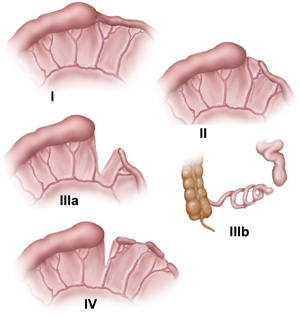
Jejunoileal atresia is broken down into four distinct structural subtypes based on the severity of the vascular disruption and the physical presentation of the bowel:
🌐 Type I: Intestinal Web
-
Anatomy: A continuous, web-like membrane or muscular wall forms inside the lumen, blocking passage.
-
Impact: The outer muscular wall of the intestine remains physically intact, and the overall length of the small bowel is completely normal.
🔗 Type II: Blind Ends with fibrous Cord
-
Anatomy: The twisted or starved section of the intestine forms a blind, closed-off pouch. This pouch is connected to the next healthy, smaller segment of bowel by a solid, non-functional band of scar tissue (fibrous cord).
-
Impact: The mesentery remains intact, and the overall length of the small bowel develops normally.
🍂 Type III: Separated Blind Ends (Vascular Flaw)
-
Anatomy: The two blind ends of the intestine are completely separated from one another, leaving a V-shaped defect or gap in the surrounding mesentery.
-
Impact: Because a large section of the intestine lost its blood supply in the womb, it reabsorbed, significantly shortening the overall length of the intestine. A classic variant is Type IIIb (“apple-peel” or “Christmas tree” atresia), where the remaining bowel wraps around a single fragile artery. This type carries a very high risk of Short Bowel Syndrome (SBS).
🍇 Type IV: Multiple Atresias (“String of Sausage”)
-
Anatomy: Involves multiple, successive blocked sections of the intestine interspersed with healthy tissue.
-
Impact: Gives the bowel a distinct “string of sausages” appearance and dramatically reduces the overall functional length of the intestine.
📋 Signs & Symptoms
The backup created by a total small bowel obstruction triggers rapid gastrointestinal distress within the first days of life:
-
🤮 Bilious Vomiting: The infant vomits dark green bile. If the blockage is high up in the jejunum, vomiting occurs within the first 24 hours. If the blockage is farther down in the ileum, vomiting may be delayed for 2 to 3 days.
-
🎈 Abdominal Distension: The baby’s belly becomes visibly swollen and bloated as gas and fluids pool behind the obstruction.
-
🛑 Failure to Pass Meconium: Unlike healthy infants, a newborn with an atresia will typically not pass their first dark stool within the first 24 to 48 hours of life.
🩺 Diagnostic Protocols
Many cases are caught early during prenatal care, but definitive structural evaluation occurs immediately after stabilizing the newborn.
Prenatal Diagnosis
-
Polyhydramnios: An abnormally high volume of amniotic fluid is often visible on a routine prenatal ultrasound. Because the fetal gut is blocked, the baby cannot naturally swallow and process the surrounding amniotic fluid, causing it to pool in the womb.
Postnatal Imaging
-
🩻 Abdominal X-Ray: Usually the first diagnostic step. It typically reveals multiple dilated, air-filled loops of small bowel with a complete absence of air in the lower colon.
-
🍑 Lower Gastrointestinal (GI) Contrast Series: A contrast agent (barium or water-soluble dye) is administered as an enema. This X-ray sequence maps the rectum and large intestine, revealing a very tiny, unused colon (microcolon) and pinpointing exactly where the obstruction starts.
-
🥛 Upper GI Contrast Series: Used if a high jejunal or duodenal obstruction is suspected. Liquid contrast is swallowed or given via a tube to visually trace the upper digestive organs.
-
🔊 Abdominal Ultrasound: Used to evaluate real-time intestinal movement and measure direct blood flow through the mesenteric vessels.
🩺 Systemic Safety Check: If life-threatening structural anomalies are suspected, an echocardiogram (heart ultrasound) or renal imaging may be ordered once the baby is fully stabilized.
🥼 Surgical Treatment
Definitive correction requires emergency surgery conducted under general anesthesia in a temperature-controlled operating room to keep the infant warm. The specific surgical technique depends entirely on the atresia type:
[ Type I (Web) ] ──▶ Bowel Incision ──▶ Web Excision ──▶ Longitudinal Closure (Jejunoplasty)
[ Type II-IV ]   ──▶ Resect Blind Ends ──▶ Taper Dilated Bowel ──▶ Primary Anastomosis (Suturing Ends)
Type I Repair
The surgeon makes a precision incision in the bowel wall directly over the internal blockage, excises the web membrane, and closes the wall longitudinally (jejunoplasty). If the surrounding tissue is unhealthy, that small segment is cut out entirely.
Type II, III, & IV Repair
The non-functional, blind pouches are surgically excised. Because the upper segment is highly stretched out and dilated, the surgeon will often “taper” or narrow it down so its width matches the smaller, unused lower bowel segment. The two open, healthy ends are then carefully sewn back together (primary anastomosis).
🔮 Postoperative Care & Long-Term Outcomes
Following surgery, the infant is closely managed in the Neonatal Intensive Care Unit (NICU).
Immediate Recovery
-
Bowel Decompression: A nasogastric (NG) tube is kept in the baby’s stomach to drain excess fluid and air, allowing the reconnected bowel to rest. This recovery process can take anywhere from a few days to several weeks.
-
Intravenous Nutrition: While the bowel is paralyzed or inactive, the baby receives all calories and nutrients intravenously via Total Parenteral Nutrition (TPN).
-
Feeding Transition: Once the bowel wakes up and starts moving, small feeds of breast milk or formula are slowly introduced via an NG tube or by mouth, while IV nutrition is gradually phased out.
Long-Term Outlook & Complications
The overall prognosis is excellent, and most infants recover with normal gastrointestinal function. However, long-term pediatric follow-up is mandatory to track physical growth and protect against potential complications:
-
Suture Line Leakage: An early risk where intestinal contents leak from the surgical connection, potentially causing a serious abdominal infection (peritonitis) that requires urgent surgical revision.
-
Functional Obstruction: Occurs if a previously stretched segment of bowel remains enlarged and fails to push food through normally.
-
Malabsorption & Short Bowel Syndrome (SBS): If a significant portion of the small intestine was lost due to a Type III or IV atresia, the baby may suffer from lifelong nutrient deficiencies, requiring permanent dietary alterations or specialized long-term feeding assistance.